



Brainzy is an interactive learning platform designed to help children practice important school skills through digital activities. Instead of asking children to learn only from traditional worksheets or textbooks, Brainzy brings lessons into a more playful setting with educational games, exercises, stories, songs, and other activities. The idea is simple: when learning feels like an activity children want to explore, they may be more willing to practice the same skill again and build confidence along the way.
Brainzy is associated with Education.com and is mainly focused on younger learners and elementary-age children. Its current learning areas include math, reading, and typing, with activities designed around different levels of development. For parents, the appeal is that a child can practice basic academic concepts in a format that feels less like formal homework. For teachers, it can provide another way to give students extra practice after a concept has already been introduced in class.
Quick Information About Brainzy
| Feature | Details |
|---|---|
| Type | Interactive educational learning platform |
| Main purpose | Academic practice through games and activities |
| Main subjects | Math, reading, and typing |
| Designed for | Preschool and elementary-age learners |
| Learning formats | Games, exercises, stories, songs, and videos |
| Typical users | Children, parents, teachers, and homeschool families |
| Learning approach | Game-based and interactive practice |
How Does Brainzy Work for Kids?
When a child uses Brainzy learning activities, the experience is built around doing rather than simply reading information. A child may encounter a number game, a reading activity, a story, or another exercise that asks them to make a choice or complete a small challenge. This makes the learning process more active because the child has to respond to what appears on the screen instead of simply watching a lesson from beginning to end.
Another important part of Brainzy is repetition with variety. Children often need to practice the same basic idea several times before it becomes comfortable, but repeating an identical worksheet can quickly become boring. Brainzy can present practice in different interactive forms, allowing a child to work on a similar skill without every activity feeling exactly the same. Rewards and playful elements can also give children a small sense of progress, although the main value should remain the skill they are learning rather than the reward itself.
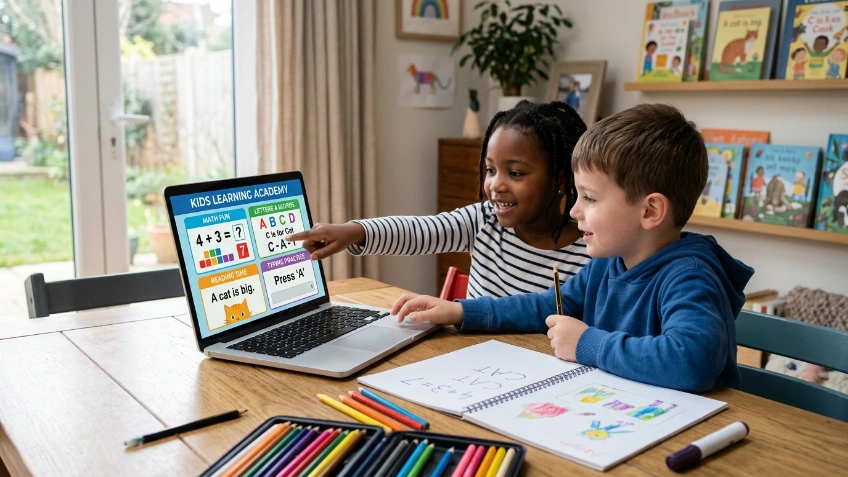
A Simple Example of Brainzy Learning
Imagine a child who is still learning how numbers work. Instead of receiving a page containing twenty counting questions, the child might complete an interactive activity where they identify numbers, count objects, or answer simple number questions. The child receives an immediate response and can continue practicing.
This approach can be especially useful when a child understands a concept partly but needs more practice. Brainzy does not make the learning happen automatically; the child still needs to think, respond, make mistakes, and try again. The platform simply places that practice inside a format that can feel more engaging than traditional repetition.
Key idea: Brainzy is best understood as a digital learning companion that turns academic practice into interactive activities.
What Makes Brainzy Different From Regular Worksheets?
Worksheets still have an important place in children’s education, but digital learning offers a different experience. A worksheet generally depends on reading instructions, writing answers, and checking the work later. Brainzy, on the other hand, can combine visuals, sounds, movement, interaction, and immediate feedback within the same activity.
That difference matters most for children who enjoy learning by interacting with things. A child may be more interested in solving a problem when it appears as part of a short game or story. At the same time, parents and teachers should not view digital activities as a complete replacement for handwriting, reading physical books, conversation, creative play, and hands-on learning. The strongest approach is usually to use different learning methods together.
Brainzy at a Glance
| Question | Simple Answer |
|---|---|
| What is Brainzy? | An interactive educational platform for children |
| How do children learn? | Through games, exercises, stories, songs, and other activities |
| What does Brainzy teach? | Foundational math, reading, typing, and related skills |
| Is it only for school? | No. It can also be used for practice at home |
| Can parents use it? | Yes, parents can use it as an additional learning resource |
| Can teachers use it? | Yes, it can support classroom and student practice |
What Subjects and Skills Does Brainzy Teach?
Brainzy is mainly built around foundational skills that children need during their early school years. Its current Guided Lessons include online games and exercises for math, reading, and typing, and Education.com lists Brainzy for learners from pre-K through 5th grade. The important thing is that these subjects are not presented only as traditional lessons. Children practice through interactive activities that ask them to recognize, choose, solve, read, or respond, which can make repeated practice feel more active. For example, Education.com’s broader learning-game collection includes activities covering counting, fractions, phonics, sight words, grammar, multiplication, division, and typing skills.
The value of this approach is that Brainzy learning can meet children at different stages of development. A beginner may spend time recognizing letters or counting objects, while a more advanced learner can work on addition, reading comprehension, or keyboard skills. This does not mean every child will master a subject simply by playing games. Instead, Brainzy is better viewed as a practice environment where children can reinforce concepts they are learning at home or school.
Brainzy Math Games and Activities
Math is one of the main areas in Brainzy for kids, and the activities can introduce or reinforce skills that develop gradually. Early learners may work with numbers, counting, patterns, shapes, and basic number concepts. As children move into higher grades, activities can become more challenging and may involve operations and other mathematical ideas. Education.com’s learning-game library, for example, currently includes games covering skills such as addition, multiplication, division, fractions, and other math concepts.
One useful feature of game-based math practice is that it gives children an opportunity to use a skill instead of only reading about it. A child who has just learned addition might answer questions inside a short interactive challenge rather than completing a long page of similar problems. This can be helpful for practice, especially when the goal is to build familiarity and confidence. However, parents should still encourage children to explain how they reached an answer because understanding the reasoning behind a mathematical problem is more important than simply choosing the correct answer.
Math skills Brainzy-style activities can support include:
- Number recognition and counting
- Basic addition and subtraction
- Shapes and patterns
- Multiplication and division practice
- Fractions and other age-appropriate concepts
- General number fluency
Interesting fact: Education.com says its broader learning-game collection includes more than 400 math games, showing how widely game-based practice can be used across different mathematical skills.
Brainzy Reading and Language Activities
Reading is another major part of Brainzy learning. Early reading development can involve several connected skills rather than one single ability. Children first need to become familiar with letters and sounds, then begin connecting those sounds to words, recognizing common words, building vocabulary, and eventually understanding what they read. Interactive activities can give children repeated opportunities to practice these smaller skills before they become more confident readers.
Brainzy and Education.com’s wider game collection include activities around letters, phonics, sight words, spelling, sentences, grammar, and reading comprehension. This is particularly useful because reading development does not happen at exactly the same speed for every child. One learner may need more phonics practice, while another may already decode words but need additional help understanding sentences and passages.
Does Brainzy Include Typing Activities?
Yes, Brainzy includes typing activities along with math and reading lessons. These activities help children become familiar with using a keyboard while they learn. Since many students now use computers for schoolwork, basic typing skills can make digital learning easier and more comfortable.
Children can practice finding letters, numbers, and punctuation marks on the keyboard. They can also work on typing accuracy and gradually improve their speed. The main goal is not to make children type as fast as possible, but to help them type correctly and feel comfortable using a keyboard.
What Age and Grade Is Brainzy For?
Brainzy is currently designed for pre-K through 5th grade, according to Education.com’s support information. That range covers a large part of a child’s early academic development, so the experience can look quite different depending on the learner’s grade. A preschool child may need simple activities involving letters, numbers, shapes, and basic recognition, while an elementary student may need more advanced reading, math, or typing practice.
It is also worth separating Brainzy’s grade range from Education.com’s overall grade range. Education.com offers resources from preschool through 8th grade, but its Brainzy online games and exercises are specifically offered through 5th grade. This distinction matters for parents searching for resources for older children because finding an Education.com resource for a particular grade does not necessarily mean that the same activity is part of Brainzy.
Is Brainzy Good for Preschool and Pre-K?
For younger children, Brainzy can be useful for introducing foundational academic ideas in a playful environment. Preschool and pre-K learners are still developing basic concepts such as recognizing letters, understanding numbers, identifying patterns, and following simple instructions. Interactive activities can give them a chance to practice these ideas without making every learning session feel like formal schoolwork.
However, young children usually benefit from learning experiences beyond a screen. A child can practice counting through toys, recognize letters in a storybook, learn shapes by drawing them, or develop language skills through conversation. Brainzy can fit alongside these activities rather than replacing them. For early learners, balance is especially important.
Is Brainzy Good for Kindergarten?
Kindergarten is often a major transition period because children begin connecting the foundational skills they have encountered earlier with more structured academic learning. Brainzy can provide additional practice in areas such as early reading, phonics, sight words, counting, and basic mathematics.
The biggest advantage here is repetition without making every practice session identical. If a child has already been introduced to a concept in school, an interactive Brainzy activity can provide another opportunity to use that knowledge. Parents can also use the activities to notice which areas seem comfortable and which ones may require more practice.
Is Brainzy Good for First Grade and Older Children?
Yes, Brainzy continues into elementary school and currently covers learning activities through 5th grade. At these levels, children are generally moving beyond basic recognition and beginning to apply skills more independently. Math activities can become more demanding, while reading activities can move toward stronger comprehension and language skills.
One important point is that grade level does not always equal ability level. A child in second grade may need first-grade practice in one subject and be ready for more advanced work in another. Education.com’s Brainzy system allows the grade level displayed for a child’s content to be changed, and parents or teachers can also lock or hide grade levels when needed.
Brainzy Grade Levels at a Glance
| Learning Stage | Possible Focus |
|---|---|
| Pre-K | Early numbers, letters, shapes, and foundational concepts |
| Kindergarten | Phonics, sight words, counting, early math, and reading |
| Grade 1 | Basic operations, reading development, typing, and language |
| Grades 2–3 | Stronger math, reading, grammar, and keyboard practice |
| Grades 4–5 | More advanced math, reading, language, and typing skills |
Fact: One Education.com Premium membership can provide access across the available grade levels, rather than requiring a separate membership for each grade. Brainzy itself currently covers pre-K through 5th grade.
What Are the Main Brainzy Features?
The main appeal of Brainzy educational games is that learning is presented through several types of digital experiences instead of a single format. Children can access games, songs, and stories, while the wider Guided Lessons environment also provides structured exercises. Education.com describes Brainzy as its interactive Guided Lessons experience for math, reading, and typing. This variety can matter because children do not always respond to the same learning format.
Another useful feature is that Brainzy is not designed only for children to explore independently. Parents and teachers can play a role in deciding what students practice. Premium members can create assignments containing games or exercises, set the number of attempts, and even make an assignment mandatory. This gives adults more control when Brainzy is being used as part of a structured learning routine.
Brainzy Educational Games
Games are at the center of the Brainzy experience. Rather than simply presenting a question on a blank screen, activities can place academic practice inside a small challenge or story. Education.com’s current game collection includes examples such as multiplication, division, addition, phonics, sight words, reading, grammar, and typing activities.
The important educational point is purposeful practice. A game is useful when the child is actually practicing a skill while playing. If the child remembers only the game but cannot explain or use the underlying concept elsewhere, the activity has limited value. Parents can strengthen the experience by asking simple questions afterward, such as, “How did you know that was the right answer?”
Brainzy Songs, Videos, and Stories
Brainzy also includes songs and stories, giving children another way to interact with educational content. These formats can be especially appealing to younger learners because rhythm, repetition, characters, and storytelling can make unfamiliar ideas easier to approach.
Stories can also connect learning with context. Instead of seeing a word or number as an isolated item, a child may encounter it as part of a larger activity. Still, children should continue reading physical and digital books outside the platform because developing strong literacy involves much more than completing online exercises.
Brainzy Characters and Learning World
Another part of the experience is the use of recurring characters and a playful learning environment. Familiar characters can give children a sense that they are returning to a world they already know rather than opening a completely new lesson every time.
This can have a simple practical benefit. When children feel comfortable with the environment, less attention may be spent figuring out how the activity works and more attention can go toward the learning task. That does not mean characters automatically improve academic results, but they can help create a more inviting environment for practice.
Brainzy Coins, Awards, and Paint
Brainzy also includes a reward system involving coins, awards, and Paint. According to Education.com’s support information, children with profiles can earn coins or badges through games, use coins in the Shop, and use purchased items within the Paint program to create drawings. Their pictures can also be downloaded and printed.
These features add a creative and motivational layer to the experience. For some children, earning a small reward can make them more interested in completing another activity. Parents and teachers should still keep the focus on learning, because the strongest outcome is not collecting coins but building a skill the child can use outside the game.
Brainzy Assignments for Parents and Teachers
Assignments make Brainzy more useful when an adult wants to guide a child’s practice. Education.com’s assignment system allows Premium members to select a worksheet, game, exercise, or Guided Lesson and assign it to a student. Teachers or parents can also choose whether an assignment is mandatory and determine how many attempts a learner receives.
This can be helpful when a child needs targeted practice. Instead of telling a student to “play some math games,” a teacher could direct the student toward an activity connected to a skill currently being studied. That turns Brainzy from simple entertainment into a more intentional part of a learning routine.
What Are the Benefits of Using Brainzy for Kids?
One of the clearest benefits of Brainzy for kids is that it can make repeated academic practice feel less repetitive. Children often need to revisit the same skill many times before they become confident, but traditional repetition can sometimes feel tiring. Interactive games and activities provide another format for that practice, which may help keep children interested.
Brainzy can also give parents and teachers another way to support learning outside a standard lesson. Education.com describes its wider platform as providing digital and printable resources, while Brainzy provides interactive Guided Lessons. This means a child can potentially move between different learning formats depending on what they need.
Makes Learning More Interactive
Interactive learning requires children to do something with the information. They may select an answer, identify a word, solve a problem, or complete a challenge. This is different from simply watching a video or reading a page.
For some learners, that active approach can make practice more interesting. It also gives the child an immediate opportunity to see whether an answer worked, which can encourage another attempt when they make a mistake.
Helps Children Practice Foundational Skills
Early academic skills are often built through repeated practice. Reading depends on several smaller abilities, just as mathematics depends on understanding numbers and operations before more complex concepts become comfortable.
Brainzy can provide additional opportunities to practice these foundations. The important word is additional. Children still need explanations, conversations, books, writing practice, hands-on activities, and guidance from adults.
Encourages Independent Learning
A well-designed digital activity can allow children to work through small challenges without an adult standing beside them for every question. This can help children become more comfortable trying something on their own.
Independence does not mean parents should completely step away. Younger children may need help understanding instructions, while struggling learners may need an explanation that a game cannot provide. The best use is often a combination of independent practice and adult support.
Gives Parents and Teachers More Learning Options
Brainzy can give adults another tool when a child needs extra practice. Teachers can use Classroom Mode and student accounts, while parents can use individual child profiles and assignments. Education.com says Classroom Mode supports up to 35 students and lets teachers control certain settings, including grade levels and access to Paint and Shop.
That flexibility can be useful in different environments. A teacher might use an activity during independent practice, while a parent might use it for a short session after homework.
Can Make Screen Time More Educational
Not all screen time has the same purpose. There is a meaningful difference between spending time watching random entertainment and spending a short period solving reading or math problems.
That does not make educational screen time automatically better or unlimited. Children still need sleep, physical activity, social interaction, outdoor play, creative activities, and offline learning. Brainzy works best when it becomes one part of a balanced routine rather than the entire routine.
How Do Parents and Teachers Use Brainzy?
Parents can use Brainzy learning activities at home as a supplement to everyday education. A simple routine might involve choosing one skill the child is currently learning, allowing a short period of digital practice, and then connecting that skill to an offline activity. For example, after a math game, a parent could ask the child to solve a similar problem using paper or objects.
Teachers can use Brainzy more formally by assigning specific games or exercises. Education.com’s Classroom Mode allows students to enter through a classroom code, and teachers can manage certain aspects of the student experience from their account. Up to 35 students can play simultaneously according to Education.com’s current support documentation.
How Parents Can Use Brainzy at Home
A good approach is to avoid turning every Brainzy session into a test. Let the child explore, but pay attention to areas where they repeatedly struggle.
Parents can:
- Choose activities related to current schoolwork.
- Keep sessions reasonably short and focused.
- Ask children to explain answers.
- Combine digital practice with books and hands-on activities.
- Celebrate improvement rather than only perfect scores.
How Teachers Can Use Brainzy in the Classroom
Teachers can use Brainzy as a supplemental practice tool rather than treating it as the entire lesson. A teacher can introduce a concept personally, allow students to practice it through a Guided Lesson, and then return to discussion or written work afterward.
Classroom Mode also provides useful controls. Teachers can manage grade-level settings and can prevent access to features such as Paint and Shop when they want students to remain focused on assigned learning.
Can Brainzy Be Used for Homeschooling?
Yes, but Education.com itself describes its homeschool resources as supplemental, which is an important distinction. Its Guided Lessons are available for pre-K through 5th grade, while its broader Premium library covers additional grades and includes worksheets, lesson plans, activities, and other resources.
For a homeschool family, Brainzy can therefore work as one piece of a larger plan. A parent could use it for extra math or reading practice while using books, writing exercises, experiments, discussions, and hands-on projects for other parts of the child’s education.
Is Brainzy Free, Safe, and Worth Using?
The answer depends on what you expect from it. Brainzy can be valuable for families looking for interactive academic practice, particularly when a child enjoys learning through games. But parents should understand the difference between free access, Premium access, and the broader Education.com resource library before deciding whether it fits their needs.
Education.com’s current support information says its Basic membership is free but provides limited monthly access to content, while Premium provides unlimited access to its resources and Brainzy’s interactive Guided Lessons. Because membership details can change, families should always check the current terms before purchasing.

Is Brainzy Free to Use?
Education.com currently offers a Basic free membership, but its support documentation says Premium is required for unlimited access to Brainzy. This means “Is Brainzy free?” does not have a simple yes-or-no answer.
The more accurate answer is that some Education.com content is available without payment, while full Brainzy access is associated with Premium membership. This distinction is useful for parents who want to test the platform before paying.
What Does a Brainzy Premium Membership Include?
Premium access includes unlimited access to Brainzy’s interactive Guided Lessons for math, reading, and typing, along with Education.com’s wider digital and printable resources. For parents with multiple children, one Premium membership can cover the family’s children across the available grade levels.
Teachers also have a different use case. Education.com states that a teacher Premium membership can support access for up to 35 students.
Can You Use Brainzy on a Phone, Tablet, or Computer?
Brainzy can be accessed through a web browser. Education.com’s support documentation says users can access Brainzy games, songs, and stories through the website and recommends Chrome.
This means families do not necessarily need a dedicated computer for Brainzy. A supported phone or tablet can also be used, although the exact experience may depend on the device, browser, screen size, and current technical requirements.
Is There a Brainzy App?
According to Education.com’s current support information, there is not a supported Education.com app at this time. However, users can still access their Premium benefits through a mobile device by logging into Brainzy through the browser.
For parents, this is an important practical detail. Searching for an app in an app store is not necessary when the service can be accessed through the web
Is Brainzy Safe and Worth Using for Kids?
Brainzy is designed specifically around children’s learning, and Education.com’s Classroom Mode describes the Guided Lessons environment as kid-safe and ad-free for students using that classroom setup. Even so, parents should remain involved in their children’s online learning, especially with younger children.
Digital safety is not only about advertisements. Parents should also understand how child profiles work, what information is being used, and how students access their accounts. Education.com’s support resources include separate controls for student access, grade levels, and other Brainzy features.
Is Brainzy Actually Educational?
Yes, its activities are designed around academic skills rather than being games with unrelated educational claims. Current Education.com materials describe Brainzy as interactive Guided Lessons covering math, reading, and typing.
The more useful question, however, is whether it is educational for a particular child. A good learning activity should help the child understand or practice something they can eventually use outside the platform. If a child is only chasing rewards without understanding the skill, the educational value becomes weaker.
What Are the Pros and Cons of Brainzy?
| Pros | Cons |
|---|---|
| Interactive learning activities | Does not replace a complete curriculum |
| Math, reading, and typing practice | Full access requires Premium |
| Games can make repetition more engaging | Younger children may need adult guidance |
| Parent and teacher assignment options | Screen time still needs to be balanced |
| Child-friendly learning environment | Not every activity will suit every learner |
| Can support home and classroom practice | Digital practice should complement offline learning |
Who Is Brainzy Best For?
Brainzy may be a good fit for:
- Preschool and elementary-age children.
- Parents looking for additional academic practice.
- Teachers who want interactive supplemental activities.
- Homeschool families needing digital reinforcement.
- Children who respond positively to game-based learning.
It may be less suitable as the only learning resource for a child. No single website can replace a complete educational experience, particularly for skills that require conversation, writing, physical activity, social interaction, creativity, or hands-on exploration.
Frequently Asked Questions About Brainzy
1. What is Brainzy?
Brainzy is an interactive educational learning platform associated with Education.com. It provides children with digital games and exercises designed around academic practice, particularly math, reading, and typing. Brainzy also includes experiences such as songs and stories that make the learning environment more engaging for younger students. Education.com currently lists Brainzy’s Guided Lessons for pre-K through 5th grade. It is primarily designed as a supplemental learning tool, meaning parents and teachers can use it alongside classroom teaching, homework, books, worksheets, and hands-on activities. The main idea behind Brainzy is to make repeated academic practice feel more interactive and approachable for children.
2. What age is Brainzy for?
Brainzy is currently offered for pre-K through 5th grade, according to Education.com’s support information. That means it can serve children across several stages of early academic development. Younger learners may work on foundational concepts such as letters, numbers, and early reading, while older elementary students can encounter more advanced math, reading, language, and typing practice. However, grade level should not be treated as a perfect measure of ability. Children develop at different speeds, and a second-grade student may need simpler practice in one subject while being ready for more challenging work in another.
3. What subjects does Brainzy teach?
Brainzy’s current Guided Lessons focus on math, reading, and typing. Math activities can help children practice number concepts and age-appropriate mathematical skills, while reading activities can support areas such as phonics, sight words, spelling, language, and comprehension. Typing activities introduce children to keyboard skills and digital literacy. The exact activity a child sees depends on their grade and learning level. Because Brainzy is designed as a supplemental resource, parents and teachers can combine these activities with other forms of learning rather than relying on digital games as the child’s only source of instruction.
4. Is Brainzy free?
Brainzy has free and paid access considerations through Education.com. Education.com’s current support information says its Basic membership is free, but full unlimited access to Brainzy is included with Premium membership. Premium also provides access to the broader Education.com collection of digital and printable resources. This means families interested in Brainzy should check which activities are available under the current free membership and which require Premium. Pricing and membership terms can change over time, so it is better to confirm the current details before purchasing. The important distinction is that Brainzy should not automatically be described as completely free.
5. Is Brainzy good for homeschooling?
Brainzy can be useful for homeschooling when it is treated as a supplement rather than the entire curriculum. Education.com describes its homeschool resources in this way, with Guided Lessons available for pre-K through 5th grade. A homeschool parent could use Brainzy to provide extra practice after teaching a math or reading concept through books, discussion, writing, or hands-on activities. Interactive games can also provide variety when a child becomes tired of traditional worksheets. However, a complete homeschool program usually needs many other elements, including reading, writing, mathematics, science, social learning, creative work, and real-world activities.
Final Verdict: Is Brainzy Worth Trying?
Brainzy is a child-focused interactive learning platform that turns academic practice into games, exercises, stories, songs, and other digital activities. Its current Guided Lessons focus on math, reading, and typing for learners from pre-K through 5th grade.
Its biggest strength is not that it makes learning effortless. Rather, Brainzy gives children another way to practice skills they are already developing. For a child who enjoys interactive activities, this can make repetition more interesting and can give parents and teachers another useful resource.
The best way to think about Brainzy learning is as one part of a larger educational routine. Use it alongside books, writing, conversation, hands-on activities, classroom instruction, and creative play. When used in that balanced way, Brainzy can be a practical and engaging tool for helping children practice important skills while making learning feel a little more enjoyable.
Read more at : Myolsd.info