


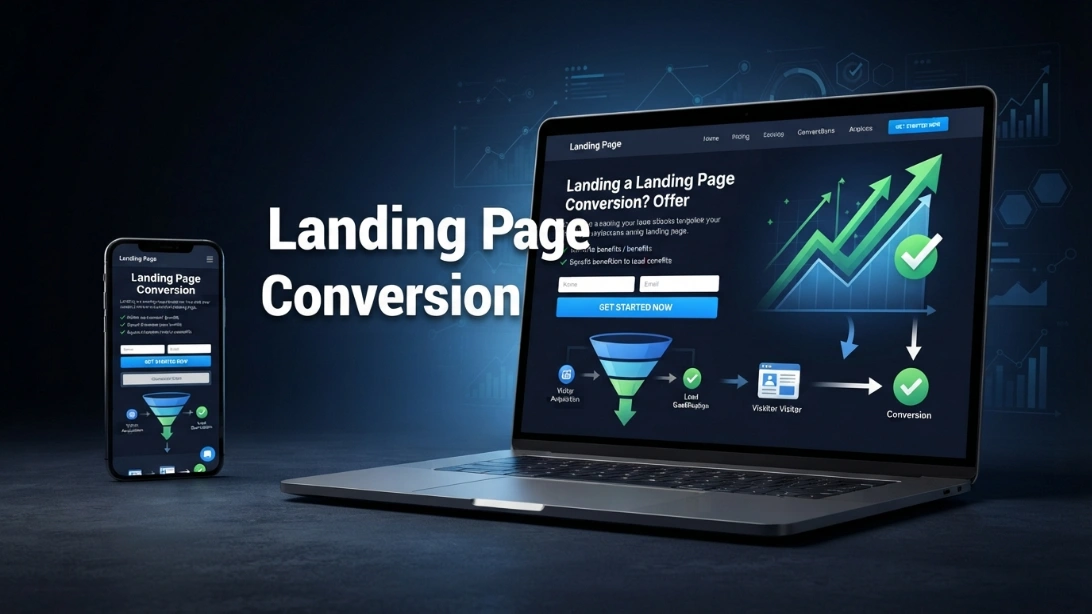
A landing page conversion happens when a visitor completes the main action you want on a landing page. This action could be filling out a form, buying a product, signing up, downloading a guide, or booking a service.
The goal is simple: turn website visitors into leads or customers. A good landing page removes distractions and guides visitors toward one clear action.
| Quick Information | Details |
|---|---|
| Main goal | Get visitors to take action |
| Common actions | Signup, purchase, download, booking |
| Key metric | Conversion rate |
| Main focus | One clear call to action |
How Does a Landing Page Conversion Work?
A landing page usually starts with a clear headline. It then explains the offer and shows visitors why it is useful.
A strong call to action (CTA) tells visitors what to do next. For example, “Get Started,” “Book a Demo,” or “Download Now” gives the visitor a clear path.
The basic journey looks like this:
Visitor → Landing Page → Offer → CTA → Conversion
The page should answer the visitor’s main questions quickly. It should explain the value, build trust, and make the next step easy.
What Counts as a Landing Page Conversion?
A conversion depends on the purpose of the page. Not every conversion means making a sale.
Common examples include:
- Completing a contact form
- Creating an account
- Buying a product
- Booking a consultation
- Downloading an ebook
- Signing up for a newsletter
- Requesting a free trial
For example, a software company may consider a free trial signup a conversion. An online store may count a completed purchase instead.
How Do You Calculate Landing Page Conversion Rate?
The landing page conversion rate shows how many visitors completed the desired action.
The basic formula is:
Conversion Rate = (Conversions ÷ Total Visitors) × 100
For example, if 1,000 people visit your landing page and 50 complete the desired action:
50 ÷ 1,000 × 100 = 5%
So, the landing page conversion rate is 5%.
| Visitors | Conversions | Conversion Rate |
|---|---|---|
| 500 | 25 | 5% |
| 1,000 | 50 | 5% |
| 2,000 | 100 | 5% |
A higher rate is often better, but there is no single conversion rate that works for every business. Industry, traffic source, offer, audience, and page purpose all matter.
How Can You Improve Landing Page Conversions?
Start with the headline and offer. Visitors should understand what you are offering within seconds.
Keep the page focused on one main goal. Too many buttons, links, and competing offers can distract visitors.
Your CTA should also stand out. Use clear words that explain the benefit instead of vague wording.
Trust can make a major difference too. Customer reviews, testimonials, guarantees, security information, and recognizable trust signals can reduce hesitation.
Simple Ways to Improve Conversion
| Improvement | Why It Helps |
|---|---|
| Clear headline | Explains the offer quickly |
| Strong CTA | Shows visitors what to do |
| Short form | Reduces effort |
| Social proof | Builds trust |
| Fast loading | Improves user experience |
| Mobile design | Helps phone users |
| Simple layout | Reduces distractions |
Landing Page Conversion vs Conversion Rate
These terms sound similar but mean different things.
A landing page conversion is the action completed by a visitor. The conversion rate measures how often that action happens compared with the number of visitors.
Think of it this way:
Conversion = the action.
Conversion rate = the percentage of visitors who take that action.
Understanding this difference makes it easier to analyze landing page performance.
Final Thoughts
A landing page conversion is simply a desired action completed by a visitor. It could be a purchase, signup, download, booking, or lead form submission.
The best landing pages are usually clear and focused. They explain the offer, build trust, and give visitors an easy reason to click the CTA.
Small improvements can make a meaningful difference. Test your headline, offer, CTA, form, page speed, and layout to find what works best for your audience.
FAQs
What is a landing page conversion?
A landing page conversion happens when a visitor completes the main action a page is designed to generate. This could be buying something, submitting a form, signing up, booking a service, or downloading content.
What is a good landing page conversion rate?
There is no universal number. A good rate depends on the industry, audience, traffic source, offer, and conversion goal. Comparing your results over time can be more useful than following one fixed benchmark.
How can I increase landing page conversions?
Use a clear headline, strong offer, simple design, visible CTA, short forms, social proof, and fast loading speed. Testing different versions can help identify what works best.
Why do landing pages need a CTA?
A CTA gives visitors a clear next step. Without one, visitors may not know what action they should take after reading the page.
Does mobile design affect conversions?
Yes. Many visitors use smartphones. A landing page should load quickly, display properly on smaller screens, and make buttons and forms easy to use.
Read more : Xendit Gamification Summit: What It Is and How It Works