


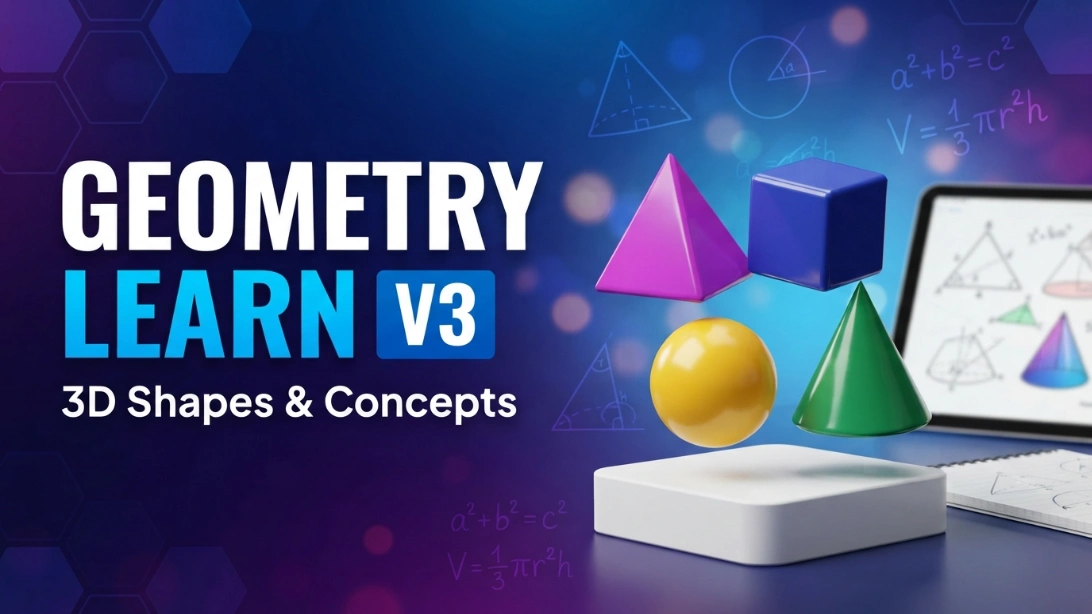
Geometry can feel confusing when you only see formulas and diagrams. Geometry Learn V3 takes a more visual approach. It helps learners understand shapes, angles, measurements, and other geometry ideas in a way that feels easier to follow. Instead of simply memorizing a formula, students can focus on understanding what the formula means and when to use it.
For students who struggle with traditional geometry lessons, this kind of learning approach can make a real difference. It can turn an abstract idea into something easier to see and understand. In this guide, we will look at what Geometry Learn V3 is, what learners can study with it, and how it can support better geometry practice.What Is Geometry Learn V3?
Geometry Learn V3 is a learning-focused approach to geometry that can help students explore mathematical ideas through visual examples, shapes, measurements, and problem-solving activities. Geometry is not only about remembering rules. It is also about seeing how different parts of a figure relate to each other. A good learning tool can make these relationships easier to understand. For example, instead of only reading that the angles in a triangle add up to 180 degrees, a learner can study different triangles and see how the angles work together. This makes the idea easier to remember because there is an actual concept behind the number.
| Quick Information | Details |
|---|---|
| Topic | Geometry learning |
| Main focus | Shapes, angles, measurements, and problem solving |
| Learning style | Visual and interactive |
| Useful for | Students and independent learners |
| Main benefit | Makes geometry concepts easier to understand |
The value of Geometry Learn V3 is mainly in making geometry less intimidating. Many students find geometry difficult because a question may contain several pieces of information at once. You may need to identify a shape, understand its angles, choose a formula, and then calculate the answer. Breaking these ideas into smaller steps can make the process much easier. The goal is not just to get the right answer; it is to understand why the answer is right. That understanding becomes useful later when students face more advanced topics such as similarity, congruence, transformations, coordinate geometry, and geometric proofs.
Key idea: Geometry becomes easier when students understand the picture behind the formula.
Why Geometry Learn V3 Can Be Helpful
A visual learning method can be especially useful for students who find textbook explanations difficult. Geometry is naturally visual, so seeing a line move, an angle change, or a shape become larger can provide a clearer explanation than words alone.
Students can also learn at their own pace. If a topic feels difficult, they can spend more time on it before moving forward. This is important because geometry topics are often connected. A weak understanding of angles can make triangles harder, while difficulty with triangles can later affect work with polygons and proofs.Geometry Learn V3 Features and Learning Tools
One of the useful ideas behind Geometry Learn V3 is learning through visuals instead of relying only on written explanations. Geometry involves many things that are easier to understand when you can see them. A triangle, for example, is not just three lines joined together. Its sides, angles, height, and area all have a relationship. Visual learning helps students notice these connections without making the subject feel overly technical. Interactive examples can also make practice more interesting because learners can focus on how a figure changes and what happens when one part is changed.
Another important part of geometry learning is practice. Reading a formula once does not always mean a student understands it. Geometry Learn V3 can be used as a practice-focused learning method, where students work through concepts and then apply them to problems. This approach is helpful because mistakes become part of the learning process. Instead of seeing an incorrect answer as failure, students can look at where their calculation or reasoning went wrong. Over time, this builds stronger problem-solving habits and more confidence.
| Feature | How It Helps |
|---|---|
| Visual examples | Makes difficult ideas easier to see |
| Shape exploration | Helps students understand properties |
| Practice problems | Builds calculation and reasoning skills |
| Step-by-step learning | Prevents students from feeling overwhelmed |
| Self-paced study | Gives learners more control |
Geometry Topics You Can Learn With Geometry Learn V3
Geometry covers much more than basic shapes. Beginners usually start with points, lines, line segments, rays, and angles. These ideas may look simple, but they create the foundation for almost everything that comes later. Students then move into triangles, quadrilaterals, polygons, and circles. Geometry Learn V3 can make these topics easier to approach because each concept can be connected to a visible figure rather than being treated as a collection of rules.
As learners become more comfortable, they can move toward topics that require deeper reasoning. These include area, perimeter, volume, surface area, transformations, similarity, congruence, and coordinate geometry. Geometry also introduces students to proofs, where they must explain why a mathematical statement is true. This is an important change in thinking. The student is no longer only calculating an answer. They are learning how to build a logical argument from known facts.
A Simple Geometry Learning Path
A sensible learning order can make geometry much less stressful. Students should first become comfortable with basic terms and measurements. After that, they can study shapes and their properties before moving toward formulas and more complex problems.
A simple progression looks like this:
Basic concepts → Angles → Triangles → Polygons → Circles → Measurement → Transformations → Coordinate geometry → Proofs
This order is not a strict rule. Some students may move faster, while others may need more practice at each stage. The important point is to build one skill on another instead of trying to memorize everything at once.
How to Use Geometry Learn V3 Effectively
The best way to use Geometry Learn V3 is to treat it as a learning aid rather than a shortcut to answers. Start with a topic that you already partly understand. Study the example carefully, then try a similar question without looking at the solution. This small step matters because it shows whether you actually understand the idea. If you make a mistake, return to the example and find the exact point where your thinking changed direction.
Regular practice is also more useful than studying for several hours only once a week. Even a short geometry session can help when it is done consistently. Try to understand the reason behind each formula. For example, when learning the area of a triangle, do not only remember ½ × base × height. Think about why a triangle can be related to a rectangle or parallelogram. When the reason becomes clear, remembering the formula becomes much easier.
A Practical Study Example
Imagine a student is learning triangle area. At first, the formula may seem like something that simply needs to be memorized. With visual learning, the student can compare a triangle with a rectangle and notice why the triangle uses half of the corresponding base-and-height area. That small connection changes the lesson from memorization into understanding.
The same idea works with many other geometry topics. When studying circumference, think about the relationship between the radius and the distance around a circle. When studying transformations, focus on what happens to the position and shape of an object. The more meaning a student connects to a formula, the easier it becomes to remember and use.
Geometry Learn V3 vs. Traditional Geometry Learning
Traditional geometry classes still have an important role. A teacher can explain a confusing question, notice where a student is struggling, and change the explanation based on that student’s needs. Classroom learning also gives students the chance to ask questions and discuss different ways of solving a problem. These are things that a digital learning method cannot always provide in the same way.
At the same time, an interactive approach can give students more freedom to practice outside the classroom. A learner can revisit a difficult topic instead of waiting for the next lesson. Geometry Learn V3 and traditional teaching do not have to compete with each other. They can work together. A teacher can provide guidance, while digital practice gives students another way to review and explore what they learned.
| Learning Method | Main Strength |
|---|---|
| Traditional classroom | Teacher guidance and discussion |
| Textbooks | Detailed explanations and examples |
| Interactive learning | Visual exploration and practice |
| Geometry Learn V3 approach | Self-paced, concept-focused study |
| Combined approach | Broader and more flexible learning |
Common Questions About Geometry Learn V3
Is Geometry Learn V3 Good for Beginners?
Yes, a visual and step-by-step approach can be useful for beginners. Students should start with basic geometry terms before moving into harder formulas and proofs. Learning at a comfortable pace can also make the subject feel less difficult.
Can Geometry Learn V3 Help With Homework?
It can help students understand the ideas needed to solve homework problems. However, students should try to solve the question themselves instead of simply copying an answer. Understanding the method is much more valuable.
What Geometry Topics Should I Learn First?
Start with points, lines, segments, and angles. Then move to triangles, quadrilaterals, circles, area, and perimeter. Once these basics are comfortable, move toward transformations, coordinate geometry, and proofs.
How Can I Become Better at Geometry?
Practice regularly and draw diagrams whenever possible. Do not rush through mistakes. Look at why an answer was wrong and try the problem again without checking the solution immediately.
Is Geometry Learn V3 a Replacement for a Teacher?
Not necessarily. Learning tools can provide useful practice and visual explanations, but teachers can offer personal guidance and explain problems in different ways. Using both can create a stronger learning experience.
Final Thoughts on Geometry Learn V3
Geometry can seem complicated when every lesson introduces a new formula or unfamiliar diagram. The subject becomes easier when students slow down and understand the relationships between shapes, angles, measurements, and formulas. Geometry Learn V3 is useful to think of as a visual learning approach that can support this process, especially for students who learn better when they can see mathematical ideas instead of only reading about them.
The most important lesson is simple: do not focus only on getting an answer. Focus on understanding how you reached it. Practice one concept at a time, use diagrams, review mistakes, and connect formulas with real mathematical ideas. With regular practice and the right learning approach, geometry can become a subject that feels logical rather than confusing.
Read more : Rice Esther: What It Is and How the Rice Student Portal Works