





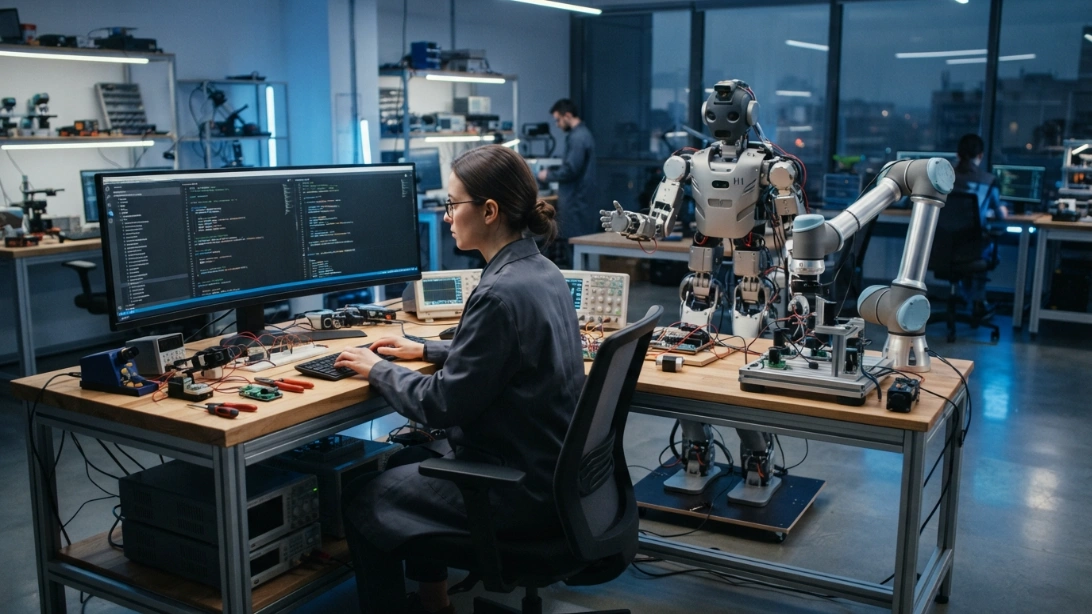
Robotics programming is the process of writing instructions that tell a robot what to do and how to do it. A robot may look like a physical machine, but its software is what gives it useful behavior. The code can tell a robot when to move, how fast to turn, what to do when it sees an object, or how to react when something blocks its path.
Think of a robot as a body that needs instructions. Its motors provide movement, its sensors collect information, and its computer processes that information. Robotics programming connects all these parts. When the parts work together, a robot can perform tasks instead of simply sitting in one place.
A basic robotic system usually has several important parts:
| Part | What it does |
|---|---|
| Sensors | Collect information from the environment |
| Controller | Processes information and runs the program |
| Motors | Move wheels, arms, joints, or other parts |
| Actuators | Create physical movement or action |
| Software | Tells the robot how to respond |
| Power system | Provides energy to the robot |
The interesting part is that robotics programming is not only about making a robot move. Modern robots can also sense their surroundings, make decisions, recognize objects, and change their actions. For example, a warehouse robot may detect another machine in front of it. Its software can process the sensor data, decide that the path is blocked, and choose another route.
How Robotics Programming Connects Hardware and Software
The connection between hardware and software is one of the most important ideas in robotics. A programmer writes code, but that code must communicate with real physical components. If the program tells a motor to rotate, the controller sends an appropriate signal to the motor system. If a distance sensor detects an object, the program receives that information and decides what should happen next.
This creates a continuous cycle. The robot senses something, processes the information, makes a decision, and performs an action. It then checks the environment again. This feedback loop allows robots to respond to changing conditions rather than following one fixed sequence from beginning to end.
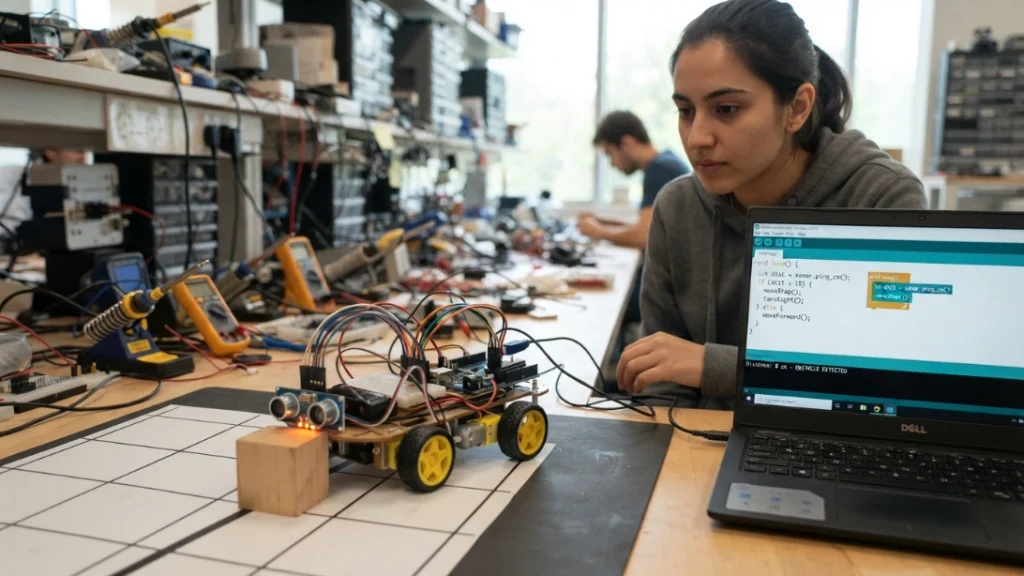
Simple idea: Robotics programming turns information into physical action.
For example, imagine a small robot designed to avoid obstacles. Its distance sensor might detect an object only 20 centimeters away. The program can recognize that the distance is too small, stop the motors, turn the robot, and continue moving. Without the program, the sensor might detect the obstacle, but the robot would not know what that information means.
What Makes Robotics Programming Different From Regular Programming?
Traditional software often works with information displayed on a screen. Robotics programming has an additional challenge: code controls the physical world. A small software mistake can cause a robot to move incorrectly, drop an object, collide with something, or damage its surroundings.
Robotics programmers therefore need to think about timing, movement, sensors, electricity, mechanical limits, and safety. They also need to understand how software behaves when real-world data is imperfect. Sensors can produce noisy readings, motors can behave differently under different loads, and physical objects rarely behave as perfectly as they do in a computer simulation.
This is why robotics programming combines several areas of knowledge. It can involve computer programming, electronics, mathematics, mechanical systems, control theory, artificial intelligence, and computer vision.
Where Is Robotics Programming Used?
Robotics programming is now used in many areas. Factories use robots for repetitive manufacturing tasks. Hospitals use robotic systems for certain medical procedures and assistance. Warehouses use autonomous machines to move products. Researchers develop robots for underwater exploration, space missions, agriculture, and scientific experiments.
The same basic idea appears in each case: software tells a physical machine how to respond to its environment. The difference is the level of complexity. A beginner robot might simply follow a line, while an advanced autonomous robot may need to understand maps, identify objects, plan routes, and react to unexpected situations.
What Does a Robotics Programmer Actually Do?
A robotics programmer creates and maintains the software that controls robotic systems. Their work can begin with a simple question: What should this robot do? From there, they turn the required behavior into software. They may write movement instructions, connect sensors, create navigation systems, process camera data, or develop software that allows different robot components to communicate.
The job is rarely just sitting and writing code. Robotics programmers often work directly with the robot. They test programs, watch how the machine behaves, find problems, adjust settings, and run the system again. A programmer might spend the morning writing code and the afternoon testing why a robotic arm is stopping a few centimeters away from its intended position.
Common Responsibilities in Robotics Programming
A robotics programmer may work on:
- Robot movement and motor control
- Sensor data processing
- Navigation and path planning
- Robotic arms and grippers
- Computer vision
- Autonomous behavior
- Robot-to-computer communication
- Testing and debugging
- Simulation and virtual testing
The exact responsibilities depend on the robot and industry. Someone working with an industrial robot may focus heavily on motion and automation. Another programmer working on an autonomous vehicle may spend more time on sensors, mapping, computer vision, and decision-making.
A Simple Example of a Robotics Programmer’s Work
Imagine a company wants a robot that moves packages around a warehouse. The robot needs to drive through different areas without hitting shelves, workers, or other machines. A robotics programmer may help create the software that reads information from cameras or distance sensors and uses that information to control the robot.
The programmer then tests the system under different conditions. What happens if a person suddenly walks in front of the robot? What if a sensor gives an incorrect reading? What if the battery becomes low? These situations require careful programming because a real robot must deal with problems that may never appear in a perfect test environment.
This is what makes robotics programming challenging and interesting: the programmer is not only writing instructions. They are teaching a machine how to behave in a physical world.
How Does a Robot Follow a Program?
A robot normally follows a continuous process rather than simply reading one instruction and stopping. Its sensors collect information, the controller processes that information, and the software decides what action should happen. The robot then uses motors or other actuators to carry out that action.
For example, a mobile robot may use a distance sensor to check the space in front of it. If the path is clear, the program tells the motors to keep moving. If an obstacle appears, the program can reduce the speed, stop, or choose another direction. The robot keeps repeating this process as it moves through its environment.
The Basic Robotics Programming Cycle
Sense → Process → Decide → Act → Check Again
This simple cycle is behind many robotic systems. More advanced robots may add several additional steps, such as building a map, identifying objects, predicting movement, or planning a longer route. However, the basic idea remains similar.
One useful way to understand this is to compare a robot with a person walking through a room. A person looks around, understands what is nearby, decides where to walk, and moves their body. A robot uses sensors instead of human senses and software instead of the human brain, but the overall process has a similar structure.
Case Study: A Simple Obstacle-Avoiding Robot
Consider a small educational robot with two wheels and distance sensors. The goal is simple: move forward until an obstacle appears, then turn and continue.
The programming logic might look like this:
- Read the distance sensor.
- Check whether an obstacle is nearby.
- Keep moving if the path is clear.
- Stop if the obstacle is too close.
- Turn the robot.
- Read the sensor again.
- Continue moving.
This project may look basic, but it teaches several important robotics programming concepts. Students learn about sensors, motor control, conditions, timing, feedback, and testing. These same ideas appear in much more advanced robotic systems.
The main difference is complexity. An educational robot may use one or two simple sensors. An autonomous vehicle can combine cameras, radar, LiDAR, GPS, maps, and sophisticated software. The foundation is still the same: collect information, process it, and use it to control physical behavior.
Which Programming Languages Are Used in Robotics Programming?
There is no single programming language that controls every robot. The best choice depends on the robot, its hardware, and what the software needs to accomplish. Python and C++ are two of the most common choices in modern robotics programming. Python is popular because its syntax is easy to understand and it works well for artificial intelligence, computer vision, data processing, and learning projects. C++ is often preferred when a robotics system needs high performance and more direct control over computing resources.
Beginners often start with Python because they can focus on learning programming concepts without dealing with too much complicated syntax. Later, learning C++ can be valuable, especially for people who want to work with ROS 2, real-time systems, autonomous robots, or professional robotics software. Other languages also have their place. C is common in embedded systems and microcontrollers, while MATLAB and Simulink are widely used for engineering, modeling, and control-system development.
| Language | Common robotics use | Beginner friendly? |
|---|---|---|
| Python | AI, vision, automation, learning | Yes |
| C++ | Robot control, ROS 2, performance | Moderate |
| C | Microcontrollers and embedded systems | Moderate |
| MATLAB | Simulation and control systems | Moderate |
| Java | Education and selected robotics systems | Yes |
Fact: Many robotics projects use more than one programming language. A robot might use C++ for low-level control while Python handles higher-level tasks such as data processing or AI.\
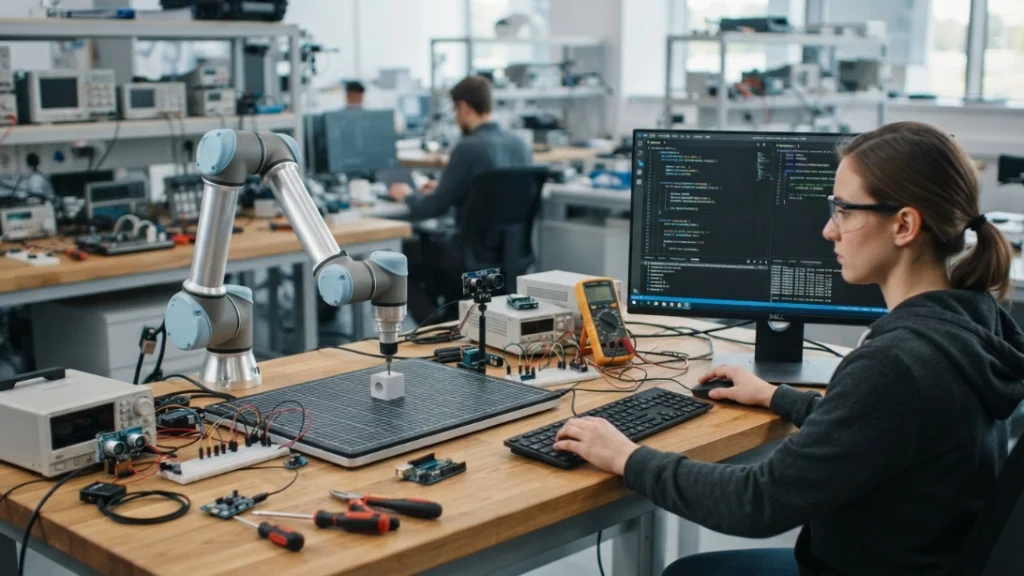
Python vs. C++ for Robotics Programming
Python is usually easier to read and write. It is especially useful when a developer is working with machine learning, computer vision, or quick prototypes. A beginner can write a small Python program and see results quickly, which makes it useful for education and experimentation.
C++ has a different advantage. It generally provides greater control and performance, which can matter when a robot needs to process information quickly or operate under strict timing requirements. In real robotics projects, the choice is often not about which language is “better.” It is about which language fits the specific job.
What Programming Language Should a Beginner Learn for Robotics?
For someone completely new to coding, Python is a practical starting point. It can teach variables, conditions, loops, functions, objects, and other programming fundamentals without creating unnecessary barriers.
Once those concepts become comfortable, learning C++ can open more doors in robotics. The important thing is not to collect programming languages. It is better to understand one language well and use it to build real projects.
Robotics Programming Frameworks, Tools, and Platforms
Programming a modern robot from scratch can become extremely complicated. Developers often use frameworks and tools that provide ready-made systems for communication, sensors, movement, simulation, and other common tasks. These tools save time and allow programmers to focus on the behavior they want to create instead of rebuilding basic robotics software.
One of the most important names in this area is ROS, or Robot Operating System. Despite its name, ROS is not a traditional operating system like Windows. It is a collection of software libraries, tools, communication systems, and development resources designed to help people build robotic applications. Modern projects commonly use ROS 2, which was designed to improve communication, reliability, and support for larger robotic systems.
What Is ROS 2 in Robotics Programming?
ROS 2 allows different parts of a robotic system to communicate with each other. For example, one software component can receive camera information while another processes that information and another controls the robot’s movement.
A ROS 2 project can be divided into separate nodes. Each node can perform a particular job. Nodes communicate through concepts such as topics, services, and actions. This structure makes large robotics projects easier to organize because developers do not have to place every function into one enormous program.
Other tools are also important. Simulation platforms allow developers to test robots in virtual environments before using expensive physical machines. Development boards such as Arduino and Raspberry Pi are popular for learning and smaller projects, while more powerful computers are used when robots need advanced vision or AI processing.
Fact: Simulation is an important part of professional robotics development because physical testing can be expensive, slow, and sometimes unsafe.
Simulation vs. Programming a Physical Robot
A simulated robot exists inside a computer-generated environment. Developers can test movement, sensors, maps, and other behaviors without immediately putting hardware at risk. This is especially useful when a mistake could cause a physical robot to crash or damage equipment.
Physical robots are still essential because simulations cannot perfectly reproduce every real-world condition. Wheels can slip, sensors can produce noisy readings, and objects may behave differently than expected. A strong robotics workflow often uses both approaches: simulate first, then test carefully on real hardware.
How to Learn Robotics Programming Step by Step
Learning robotics programming can seem difficult because it combines several subjects at once. The easiest approach is to avoid trying to learn everything immediately. Start with basic programming, then gradually add electronics, sensors, motors, robotics concepts, and more advanced software.
A beginner can first learn simple programming ideas such as variables, loops, conditions, functions, and basic problem-solving. After that, working with a small robot can make those ideas easier to understand because the code produces a visible physical result. When you tell a motor to move and actually see a wheel turn, programming becomes much more practical.
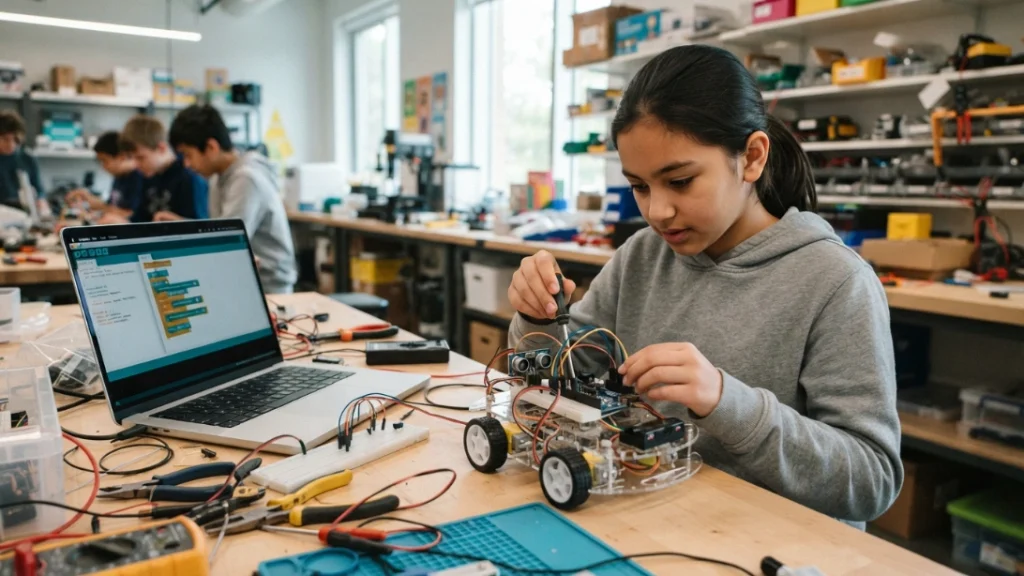
A useful learning path looks like this:
Programming basics → Electronics → Sensors and motors → Robot projects → ROS 2 → AI and computer vision
The order does not have to be perfect. Some learners begin with Arduino projects, while others start with Python and simulation. What matters most is consistent practice and gradually increasing the difficulty of your projects.
Best Robotics Programming Projects for Beginners
A simple line-following robot is a good first project because it teaches sensors and motor control. An obstacle-avoiding robot is another useful project because it introduces decision-making and feedback.
Once those projects become comfortable, a learner can experiment with a robotic arm, object detection, autonomous navigation, or a small delivery robot. Each project should introduce one or two new ideas rather than attempting everything at once.
A good beginner project should be difficult enough to teach something, but simple enough to finish.
Do You Need a Degree to Learn Robotics Programming?
A university degree can help someone build a professional career in robotics, especially for advanced engineering and research positions. However, learning robotics programming itself does not require a degree.
People can learn through practical projects, courses, books, documentation, simulations, and experimentation. A portfolio can also demonstrate useful skills. A working robot project often tells a potential employer more than a long list of technologies that someone has never actually used.
Where Is Robotics Programming Used?
Robotics programming is used wherever machines need to perform physical tasks with some level of automation or decision-making. Manufacturing is one of the best-known examples. Industrial robots can weld, paint, assemble parts, package products, and perform repetitive tasks with consistent timing.
Robotics is also expanding beyond factories. Robots are being developed for warehouses, agriculture, healthcare, delivery, inspection, education, underwater exploration, and space research. The software requirements can vary greatly, but the basic need remains the same: the robot must understand information from its environment and respond appropriately.
Major Robotics Programming Applications
| Industry | Example of robotic programming |
|---|---|
| Manufacturing | Assembly and welding |
| Warehousing | Package movement |
| Healthcare | Robotic assistance and surgical systems |
| Agriculture | Crop monitoring and automated equipment |
| Transport | Autonomous navigation |
| Space | Exploration and remote operation |
| Home | Cleaning and service robots |
| Research | Experimental autonomous systems |
One major development is the combination of robotics and artificial intelligence. Traditional robots may follow carefully defined instructions. AI-powered robots can process images, recognize objects, understand patterns, and make more flexible decisions.
Robotics Programming in AI and Autonomous Robots
AI can give robots abilities that would be difficult to achieve with simple rules. Computer vision, for example, can help a robot identify objects through cameras. Machine learning can help systems recognize patterns from data.
Autonomous robots take this idea further. They may need to create maps, estimate their location, plan routes, avoid obstacles, and respond to unexpected events. This requires several software systems working together.
Fact: Autonomous robotics is not just an AI problem. Reliable autonomy also depends on sensors, control systems, hardware, communication, software testing, and safety engineering.
Robotics Programming Careers, Skills, and Salary Potential
Robotics programming can lead to several different career paths. A person who enjoys software may become a robotics software engineer. Someone interested in machines and movement may prefer robotics engineering or controls engineering. Others may specialize in computer vision, embedded systems, automation, or autonomous systems.
The work can also vary by industry. An industrial automation professional may spend much of their time programming robotic equipment on a factory floor. A research engineer may develop experimental algorithms. A robotics software developer may spend more time writing and testing code.
Skills Needed for a Robotics Programming Career
A strong robotics programmer normally needs more than programming knowledge. Understanding basic mathematics, electronics, sensors, control systems, and algorithms can make it much easier to understand why a robot behaves in a particular way.
Important skills include:
- Programming with Python or C++
- Problem-solving
- Algorithms and data structures
- Basic mathematics
- Electronics fundamentals
- Sensors and actuators
- Robot operating frameworks
- Computer vision
- Debugging and testing
- Linux and development tools
The field also rewards patience. A robot may fail for a reason that is not immediately obvious. The problem could be software, wiring, calibration, sensor readings, mechanical friction, or timing. Good robotics programmers learn to investigate problems instead of simply changing random lines of code.
Is Robotics Programming a Good Career?
For people who enjoy technology and practical problem-solving, robotics programming can be an exciting career. Robots are being used across many industries, and software is becoming increasingly important as machines become more autonomous.
However, it is not a field where learning one programming language is enough forever. Robotics changes quickly, so professionals need to keep learning. Experience with real projects, simulation, software development, and modern robotics frameworks can be valuable when building a career.
Common Robotics Programming Challenges and Best Practices
Robotics programming has a unique challenge: software has to work with the unpredictable physical world. A program can be logically correct and still behave badly when connected to real hardware. Sensors may give inaccurate readings, motors may respond differently under different loads, and communication between devices can sometimes fail.
Timing is another major concern. A robot cannot always wait several seconds before responding to an obstacle. Some systems need to process sensor information and react within very short periods. This is why robotics programmers pay close attention to performance, reliability, testing, and safety.
How Can You Make Robotics Code More Reliable?
Good robotics software is usually divided into smaller parts. Instead of placing every task into one huge program, developers separate functions for sensors, movement, navigation, communication, and decision-making.
Testing is equally important. Developers can test individual components before combining them. They can also use simulations and controlled physical tests to identify problems early.
A few useful practices are:
- Test one component at a time.
- Keep code organized and modular.
- Record and monitor sensor data.
- Test unusual situations.
- Use simulation when practical.
- Document important settings.
- Keep backup versions of working code.
Safety should always come before speed. A robot that works quickly but behaves unpredictably is not a successful robotic system.
Robotics Programming FAQs
1. What is robotics programming?
Robotics programming is the process of creating software that controls a robot. It tells the machine how to read sensors, control motors, make decisions, and perform tasks. The programming can be very simple or highly advanced, depending on the robot. A beginner robot may only follow a line, while an autonomous machine can navigate complex environments. Robotics programming connects software with physical hardware, allowing a machine to react to real-world conditions.
2. Is robotics programming hard to learn?
It can feel difficult at first because robotics combines programming with hardware and electronics. However, beginners do not need to learn everything at once. Starting with basic Python programming and simple robot projects can make the subject much easier. As your skills improve, you can gradually learn sensors, motors, ROS 2, computer vision, and artificial intelligence.
3. Which programming language is best for robotics?
Python and C++ are both excellent choices. Python is easier for many beginners and works well for AI, computer vision, and experimentation. C++ is widely used when performance and detailed system control are important. A beginner can start with Python and later learn C++ as their robotics projects become more advanced.
4. Can I learn robotics programming at home?
Yes. You can learn many robotics programming concepts at home using a computer, simulation software, or inexpensive development boards. Simple projects can teach programming, sensors, motors, and decision-making. You do not need an expensive industrial robot to begin. Starting with small projects is often better because you can understand each part before moving toward more advanced systems.
5. Is robotics programming a good career?
Robotics programming can be a strong career choice for people who enjoy coding, engineering, and practical problem-solving. Professionals can work in manufacturing, automation, healthcare, logistics, research, autonomous vehicles, and other fields. The career requires continuous learning because robotics technology changes quickly. Building practical projects and understanding both software and basic hardware can help beginners develop useful skills for future robotics work.
Final Thoughts on Robotics Programming
Robotics programming is what allows a physical machine to do more than simply move. Through software, a robot can sense its environment, process information, make decisions, and perform actions. That combination of code and hardware is what makes robotics different from ordinary software development.
You do not need to become an expert immediately. Start with basic programming, build a small project, learn how sensors and motors work, and gradually explore more advanced tools such as ROS 2, computer vision, and AI. The most useful knowledge comes from building, testing, making mistakes, and understanding why the robot behaves the way it does.
The future of robotics programming will likely involve closer cooperation between software, AI, automation, and physical machines. As robots become more capable, programmers will play an important role in making those machines useful, reliable, and safe.